Tales from the Tartan Pro Tour with John Gallagher.
“I lost everything after a really good start. I was in such a bad spot, I missed maybe 12 or 13 cuts in a row. I was too emotional, you know, I was breaking down on the course at times. A lot of my sponsors dropped out. I remember saying, I probably shouldn’t be playing golf. I shouldn’t be doing this.”
Forget everything you thought you knew about life as a professional golfer. Big houses in Florida with 9-hole courses in the back garden. Flying around on private jets. Fame, fortune, strolling up the 18th fairway on a Sunday afternoon to the adulation of the crowd. No, it’s not about that at all. It’s sourcing decently priced hotels and cutting back on transport costs. It’s weighing up how many cuts you can afford to miss. It’s trying to attract the sponsors who can make the whole thing worthwhile. It’s trying to be competitive while working night shifts driving taxis around the streets of Edinburgh. For John Gallagher of the Tartan Pro Tour, it’s been balancing all this with grief and personal tragedy.
In his career in golf, Gallagher has reached a level that very, very few do. For most golfers, the dream is making it to single figures. Get down to scratch and you can swagger into any clubhouse in the country with your head held high. This is another level entirely. Having won the Scottish Amateur, he’s played his National Open, teed it up in the French Open and the Johnnie Walker and has represented his country on multiple occasions. He’s shared a stage with some of the biggest names in golf. And yet, his career hasn’t reached the heights he’d have hoped. It has taken monumental effort and resilience to be where he is today. So what has kept the fire in his belly and driven him on to continue competing?
“I probably thought my golf career would be a lot better than it turned out to be. But I’ve come to terms with it, and I absolutely love the game of golf. It’s kicked me sometimes but there’s something about it that will always keep me coming back.”
Life on Tour
At 44 years old, John Gallagher is one of the elder statesmen on the Tartan Pro Tour. Founded on the back of the Covid pandemic by Ryder Cup legend Paul Lawrie, the tour is based in Scotland and is a feeder to the Challenge Tour. From there, you are only one step from the DP World Tour.
Last month’s Tour Championship at Trump International marked the end of another season on the tour. 45th in the Order of Merit, it’s been a solid season competing against younger men who seem to keep getting better with every intake. There are a wealth top, top quality golfers all competing for just two spaces on the Challenge Tour. And John has seen for himself over the years that they just keep getting stronger, keep hitting the ball further, and keep getting more and more professional in their approach.
14 competitions between April and October, the players must pay entry fees to compete. With no money on offer to those who miss cuts, and limited prize money to those who do, players rely on sponsorships to survive. For Gallagher, most of his funding comes from an annual golf day that he runs at his home course, Dunningston, and from driving a private hire taxi. Last year, he drove all year round, including during the golf season.
“What I did this year was drive in the summer between tournaments, which doesn’t help, because that’s when I should be practising. If I’m driving 7 or 8 hours through the night then I’m probably not the sharpest and I’m not getting the quality practise I need to.”
Nowadays, John is realistic about his goals for the future. He knows he will not make the European Tour; his time fighting for those places has passed. But after a glistening amateur career that saw him ranked the 17th top amateur in the world, it seemed that the world was at his feet. Getting to where he is today has been a constant battle, with the game, with the course, with himself and with everything that life has had to throw in his direction. And the difficulties began as soon as he turned professional.
“Unfortunately, my story is a complicated one.”
Turning Pro- A Lonely World
Gallagher started his life in golf relatively late at 14 years of age, and he turned professional late as well, approaching his late 20s. His career as an amateur was exceptional, and he loved being able to represent Scotland for four and a half years, competing across the world.
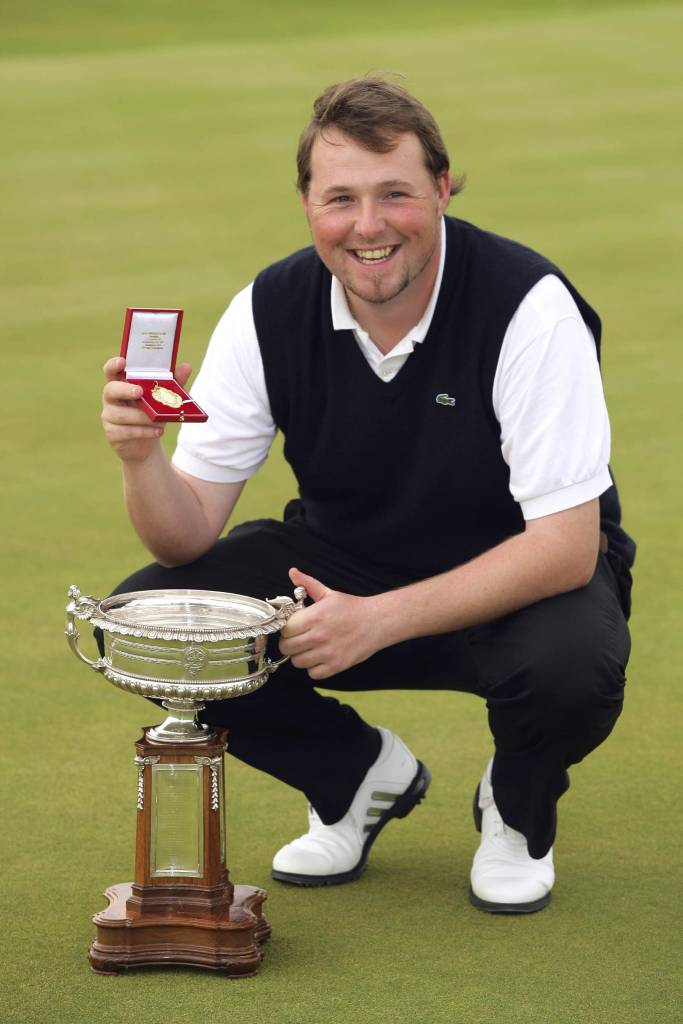
Gallagher poses with his Scottish Amateur title.
But very quickly after turning pro, it became clear what a huge jump he had to make. Not just in terms of his golfing level, but of all the logistical and financial pressures that follow. When he was representing Scotland, Gallagher was well looked after. Travel was arranged, schedules were pre-determined, he was a young man and he was able to concentrate almost exclusively on turning up and playing golf.
When you turn pro, everything changes. You’re looking for your own hotels, you’re thinking about how transport is going to work, you’re figuring out what events to play and when and so much more. You are now paying to play in events and playing golf with the added pressure of knowing that, if you miss a cut, you’re travelling back home to your family on a Friday evening empty handed. The more cuts you miss, the less your sponsors are going to be interested in you, and the financial pressures begin to accumulate. The freedom to play golf is replaced with severe pressure to perform, especially as you grow older and have a family to provide for.
Gallagher made a solid start to professional golf in terms of results. But most of the events were in England, usually in the South, and were expensive to enter. He estimates a cost of roughly £800 per tournament- £300 to enter, roughly £200 for a hotel, plus travel costs, food and drink etc, with no guarantee of any money being made.
“It was a great experience but it was so tough. It almost felt like getting back to scratch. You were really looked after on these Scottish trips, really well cared for, you’d rock up at these golf clubs with your passport and everything was done. Suddenly, and I was a bit older, it was just a different world. The travel was hard, the standard of golfer was pretty sharp, there was a bigger pool of players. It was a bit rough and it took me a couple of years to find my feet.”
The early days were a struggle, and he worried about what people back home might think of him. Had he made a mistake? How was he going to put food on the table after a missed cut?
It is noteworthy that, when talking about the difficulties of life in professional golf, the actual playing side doesn’t get that much of a mention. These players are all so good, and the margins so tiny, that whether you make the big time or not can often be down to off-the-course factors. How you deal with the loneliness and the logistical problems. Getting sponsors. The mentality, professionalism and a little bit of luck at the right time.
In spite of the difficulties, Gallagher’s talent began to shine through. He retained his card and went on to win his first events in professional golf in 2011 and 2012. Converting a promising amateur career into a high level professional one felt realistic. However, the first major setback to his career, and life, was just around the corner.
The First Loss
When you add grief to all the struggles of trying to make a living playing golf, you find yourself in an almost impossible situation. This is where Gallagher found himself after his mother’s passing. He continued playing, hoping he could get his head down and get through it. It wasn’t to be. He found himself uncharacteristically emotional on the course, and a string of 12 consecutive missed cuts followed.
Professional golf is brutal and unforgiving. As the missed cuts totted up, the sponsors began to lose interest. In acrimonious circumstances, a 5-figure sum promised to him was taken away, and suddenly his entire career looked in danger.
While he’s made great friendships over his career in golf, there is always the knowledge that everyone is ultimately your competitor. It can be hard to be open and talk when you are surrounded by people trying to take the money out of your pocket.
“You don’t really tend to open up to your fellow competitors. We had a great camaraderie, but you wouldn’t want to show weakness. I wasn’t in a great spot, but I don’t think I ever was on that tour. When you look at the Dechambeau’s of the world, they talk about “teams” a lot, generally they’re surrounded by people who are helping them. Luckily, I’ve been able to lean on my Dad and my wife over the years.”
The loss of his mother was a crushing blow. A woman who, along with John’s father, made many sacrifices to help him get started in golf and in his career. Taking after his Dad, he worked as a greenkeeper after leaving school at 16. When it became clear that he had real talent, and that being able to compete in National competitions was almost impossible while trying to hold down that job, they decided to give him two years freedom to play.
“Finances weren’t great at that time. It was tough for them. I’ll always be indebted to them for that.”
Gallagher’s decision to continue playing through the grief is one that he looks back on with regret. He needed a break, time to process things. But in a pressure cooker situation, where financial security and your entire future is on the line, it is easy to see why somebody would feel the need to play on. Tragically, this loss wasn’t to be John’s last.
Ivy
Trying for their first child, John’s wife, Lisa, fell pregnant. A little girl. After a full term of pregnancy, devastatingly, Ivy was lost just before birth.
It is impossible to imagine suffering this kind of trauma and trying to carry on playing golf. Trying to carry on doing anything, in fact. This time around, Gallagher realised that golf had to be put on the back burner while he concentrated on looking after himself and his partner. It was pointless to try and focus on anything else.
“That was a really tough time in our lives, no doubt. I still carry the burden. People think and ask, even close friends, “are you moving on?” I don’t think you ever move on from losing parents or losing children. What I think happens is that you never get over it, you just get stronger. The grief is still the same grief, you just learn to carry it better.”
As well as taking a break from golf, Gallagher also did something that he wished he’d done sooner, after the loss of his mother- talk to someone. And it is abundantly clear how much that has helped him. Not to move on, but to get stronger.
“I probably should’ve asked for help before but I didn’t, just being a guy I probably thought “I’m just gunna get through this.” When my daughter passed away I did get counselling, and it was amazing, it helped me so much and probably made me the person I am today. Because I’m very open and I’ll chat to anyone, and probably being in the taxi and speaking to people helps with that as well.”
With the tragic loss of Ivy, Gallagher had hit rock bottom. But counselling, along with the love of his wife and his family, would help him fight his way back both personally and professionally.
Gratitude, Hope, and Love for the game
While John’s story of life in professional golf has had more than its fair share of challenges, it is fair to say that it is built on a foundation of wholehearted love for the game. He loves playing, he loves competing and he loves the feeling of sitting back after a round and debriefing with his father. Whatever the level, we can all relate to that.
“I love what I do and I love competing. It’s kicked me sometimes but there’s something about it that just brings me back. It almost feels like it hurts so much because it means so much to me. But I’ll always play golf because I absolutely love it.”
The Tartan Pro Tour has offered a lifeline to John, and many other Scottish golfers. The chance to continue competing at a high level without the monetary costs of travel, hotels and the emotional cost of having to spend so much time away from family.
His goal for next season is to win a tournament, and he knows he will need to be at his best to do so. If finances allow, he is considering competing in England on the Clutch Pro Tour, as well. And there is always an eye on what sponsors could come on board and potentially change the dynamics of everything.
While there is still a lot to compete for, there is also a lot to reflect on and to be proud of.
“I’ve had some great highlights when I think about them. When I have felt down over the years and when I’m feeling a bit weaker I think to myself I should feel proud that I’ve played in the Scottish Open, because not a lot of people can say they’ve played their national open. Doing it with my cack-handed grip has made it a lot sweeter.”
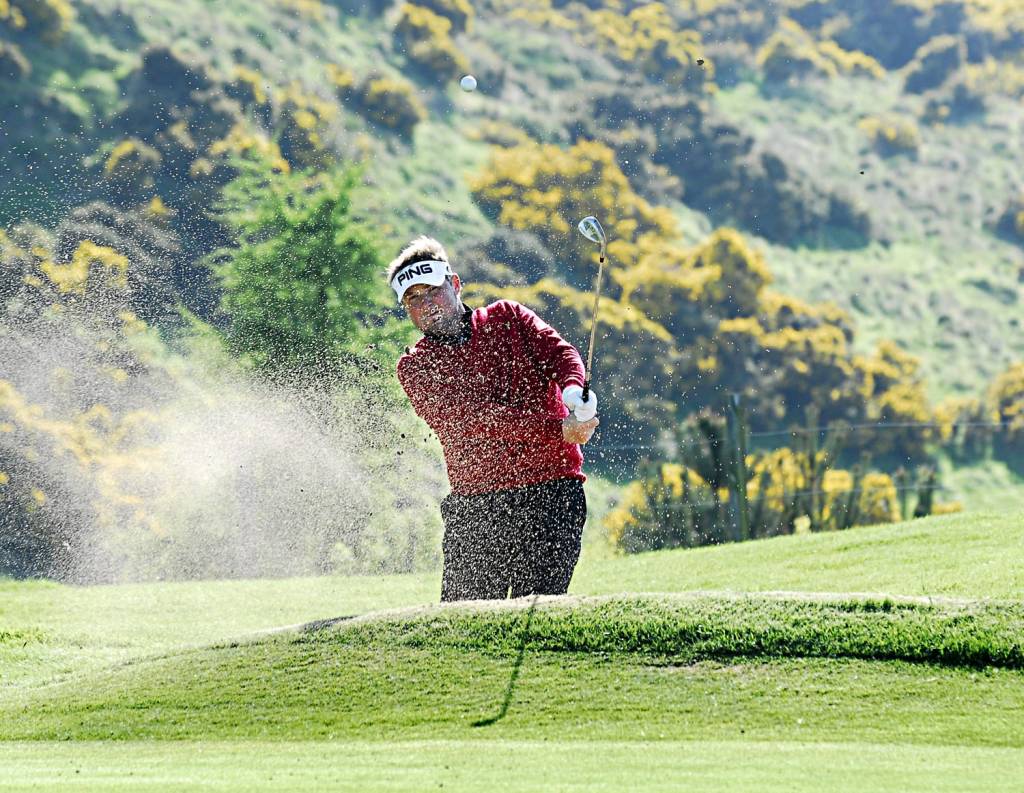
Gallagher’s “cack-handed” grip in action.
He’s learned a lot on the way. Primarily, that family comes first. He describes his Dad as his best mate, and he has a wife who loves and supports him through everything. After the tragedy they suffered, they now have a 5-year-old boy called Mason who “is amazing, absolutely brilliant.” He has found happiness in his life, and that is something that golf alone cannot bring you, even if you reach a level where mansions in Florida, private jets and adulation from the crowd become a reality.
“I talk to my wife about this. Being successful- this is something I have learned in my life. Happiness is success. Define success when you don’t know what trauma and grief is and it’s like: “I want to play in the open, I want to play in the majors”. I know people who have achieved this and it still hasn’t made them happy. I feel very fortunate to be where I am.”
What other advice would he give to young players making their way in the game? He is a big believer in doing things your own way. He never had a lesson as a junior, and adopted a grip that you will not see recommended by any coaches, “cack-handed”, with his left hand below his right. He has heard mutterings from the galleries, most notably when teeing off at the French Open. He doesn’t speak French, but the whispers didn’t sound complimentary. He followed it up with a 300 yard drive straight down the middle of the fairway. Proving people wrong. Again.
The worries over what people thought about him after he turned pro, how much money he was making, he knows now that he shouldn’t have wasted energy worrying about such things. He is long enough in the tooth to know that you should never pay too much mind to what people think about you. In life, in golf.
Many of the lessons that John has learned from golf over the years can be taken into everyday life. That’s one of the beautiful things about this sport. It teaches you so much about yourself and your temperament. From the way you carry yourself on the course, to the respect you show your opponents, your honesty, your ability to keep calm and overcome obstacles that are thrown at you relentlessly.
As in life, golf can wear you down. Whatever level you play at. Life is hard. Golf is hard. You map everything out, try your best but you can never be truly prepared for whatever it throws at you. There’s only so much you can control. When you’re at your best, it feels like nothing can stop you.
The long, carefree summer nights where he played until the sun finally went down are where John achieved the level of zen on a golf course that everyone aspires to. Once real life takes hold, you realise what a priceless, fleeting feeling that is.
“You’ll never get that enjoyment of being 15 or 16 and playing with your mates. If you could bottle that feeling up and take it into professional golf, dare I say it, I’d probably have reached a higher level.”
Golf ultimately had other plans. But for John Gallagher, the fire remains in his belly. The love for the game is as strong as ever. That’s why, as he takes the time to talk to me on a cold autumn night, he’s in the car park of a driving range. Mason put to bed, the grind continues for another year. He’s had some challenges on the way, but he’ll never give up the fight.
John wishes to thank two of his long-time sponsors, Owen Hall and Jeff Linroth. Cherished friends who have helped ensure that playing competitive golf has remained a reality.You can follow John on Instagram @johngallaghergolf, and us @from_theclubhouse or on X @FTClubhouse.



 Tales From the Clubhouse